Thursday, 12 December 2013

World AIDS Day 2013: Gems of the Collection revisited

This is a belated thank you to all those who attended both the Gems of the Collection and evening seminar on 2nd December to mark World AIDS Day 2013. The two events allowed us to showcase some of the items within the collections currently being catalogued in the School archives. It was great to see people engaging with the collections and also to meet a number of people who are currently studying or researching the disease.


The lunchtime Gems session attracted around 47 people and included items from each of the six collections along with a sample of the Library's HIV/AIDS pamphlets and books. Items included:


  • An array of documents relating to Peter Piot's tenure as Executive-Director of UNAIDS including the first newsletter of the organization and a series of his travel files that conveyed the hectic, global role the position entailed. The material also included a letter from former President Thabo Mbeki to Piot describing at length his understanding of AIDS in 2000, when the South African government would not endorse the view that HIV caused AIDS.


  • Within the AIDS Social History Programme material on display there was public health campaign material from both UK and European governments collected from the 1980s-1990s. 


 The Programme was co-directed by Professor Virginia Berridge and is a great resource for examining HIV/AIDS within the United Kingdom thanks to its mixture of publications and reports from central government, local government and voluntary groups about tackling the epidemic.


  • The papers of Professor Kaye Wellings' provide a wealth of information about AIDS public health campaigns in Europe and it's extensive newspaper clippings document the early reporting and hysteria within the popular press. 


          Relating to this the Centre of Sexual and Reproductive Health collection highlight the visual power of the AIDS public health campaigns through the posters, postcards, badges and condom packages produced by European countries in the 1980s-1990s.


          It also shows the range of mediums used to convey public health messages most notably the use of graphic novels in Belgium and Italy respectively.


  • This sample of the SIGMA research archives documents the lobbying efforts of the group to lower the age of homosexual consent to be equal to heterosexual age of consent in 1994. The archive contains a number of letters received from serving MP's both expressing their support and opposition to the amendment. 

Tuesday, 10 December 2013

An Exchange of Experience on Managing Research Data


On November 18th 2013, the London School of Hygiene & Tropical Medicine organised a two hour seminar for support staff interested or involved in RDM developments. The seminar kick-started a week of events being organised at the School to celebrate Explore Your Archives week[1], examining the emerging role that digital collections have within libraries and archives.


The seminar format was intentionally unstructured – there would be no presentations, just a set of broad topics to encourage discussion. The informal nature of the discussion created a relaxed atmosphere, which was encouraging for those who were new to the topic. The shortness of the seminar – just two hours over lunchtime – was also seen as a benefit. Participants could simply take an extended lunch break and go back to work, rather than spending half or a whole day out of the office.


In total, fifteen people attended - librarians, archivists, digital curators and policy makers – from several institutions, including Birkbeck, Royal Veterinary College, Royal College of Paediatrics and Child Health, University College London, University of East London and the University of Westminster.


The session began with an introduction from Victoria Cranna, LSHTM Archivist & Records Manager, who explained the motivation for establishing a Research Data Management Service at LSHTM and the importance of sharing knowledge and experience across the sector. It was recognised that RDM was a big topic that had developed significantly over the past few years. To ensure that the academic sector can adapt to evolving requirements, there was a need for mutual support, sharing knowledge and expertise in order to address researchers’ evolving needs.


Following introductions, each participant provided an overview of current work taking place in their institutions surrounding Research Data Management. There was a varying level of experience around the table from those who were actively working on RDM project, to those that had been tasked with finding out more information. For the most part, participants indicated that RDM work was being led by the library or archives service. An exception to this is UCL, which has RDM components being developed across the institution.


The drive to develop RDM services was motivated by several factors, including a desire to improve the likelihood that projects will be funded, comply with funder expectations for short and long-term data management (particularly EPSRC), support REF activities, provide join-up between disparate components, and address researcher needs for storage and retention of data.


The availability of funds was recognised as a key factor in the development of RDM Services. While UCL, UEL and LSHTM had benefited from dedicated funding (from JISC in the first two instances, Wellcome Trust in the latter case) other institutional representatives were developing RDM expertise using institutional funds, as a component of their existing role. As a result, work sometimes took place at a slower rate.


This led to a discussion on the relationship between institutional and national data archives, such as the UK Data Service. Although national services were considered to provide cross-sector support, they were not considered to be an appropriate replacement for local knowledge and expertise. Additionally, it was recognised that a significant percentage of research data in academia covers subject areas that are beyond the subject or geographic domain of these data repositories. Alternatives such as Dryad and Figshare are less restrictive, in terms of the content they will accept, but considered to be less prestigious for some researchers.


The role of universities in ensuring long-term preservation of research data was raised. Although, in principle, many types of data can be deleted after 10 years in principle, the complexity of international and national regulations and contractual obligations result in many institutions taking a risk adverse approach, storing data for longer than is potentially necessary. In many research communities, such as clinical trials, there is a desire to keep data forever. Although there’s a desire in academic libraries and archives to curate and preserve research data, many are unsure how they will fund such activities in the long-term.


Participants were asked if they were taking a proactive or reactive approach to RDM support. Most admitted that they were reactive, responding to issues as they emerged. However, there was a desire to provide institution-specific training workshops and web-based courses, in order to promote good practice. Although a number of sector-wide resources are available in this area, they were considered too long, cumbersome and dry. To ensure RDM material are suitable, academics need to take a leading role in its development, working in collaboration with support staff, rather than relying upon support staff to perform work.


Finally, it was asked how RDM issues could be forced on to the research agenda: should horror stories be promoted? Participants believed that this would attract attention, but may cause researchers to panic and refuse to engage. Instead, case studies that promoted a positive message, explaining how RDM practices have helped researchers to perform their work was seen as more effective.


Concluding thoughts

Events such as the RDM Expertise Exchange are increasingly important for sharing knowledge and experience between institutions. For several years, we’ve been fortunate to receive support from JISC in establishing the RDM agenda, through coordination of cross-institution activities. A grassroots approach is needed to ensure that knowledge and experience continue to be shared.


The lunchtime seminar fulfils a need that cannot be addressed by formal workshops. Participants could fit the session into their working day, without having to spend a significant amount of time out of the office. The informal nature of the session created a relaxed atmosphere, which was encouraging for those who were new to the topic, and allowed participants to have greater control over the topics being discussed. Feedback on the session was positive, with all indicating that they’d be interested in similar events being organised during 2014.

 
Further information on the School's work on Research Data Management is available on the Research Data Management Support Service Blog at: http://blogs.lshtm.ac.uk/rdmss and the Research Data Management website at: http://www.lshtm.ac.uk/research/researchdataman/index.html


[1] http://www.nationalarchives.gov.uk/archives-sector/explore-your-archive-toolkit.htm

Monday, 2 December 2013

Top 10 downloads from LSHTM Research Online - November 2013

This month's top 10 downloaded papers from LSHTM Research Online, the School’s publically accessible database of LSHTM research. 


1. Goodman, A; Panter, J; Sharp, SJ; Ogilvie, D; (2013) Effectiveness and equity impacts of town-wide cycling initiatives in England: A longitudinal, controlled natural experimental study. Social science & medicine.

2. Nyanzi, Stella; (2008) Negotiating scripts for meaningful sexuality an ethnography of youths in the Gambia. PhD thesis

3. Nguyen, NM; Tran, CN; Phung, LK; Duong, KT; Huynh, HL; Farrar, J; Nguyen, QT;
Tran, HT; Nguyen, CV; Merson, L; +15 more... (2012) A Randomized, Double-BlindPlacebo Controlled Trial of Balapiravir, a Polymerase Inhibitor, in Adult DenguePatients. The Journal of infectious diseases.

 
4. Antithrombotic Trialists' (ATT), Collaboration; Baigent, C; Blackwell, L; Collins, R; Emberson, J; Godwin, J; Peto, R; Buring, J; Hennekens, C; Kearney, P; +4 more... (2009) Aspirin in the primary and secondary prevention of vascular disease: collaborative meta-analysis of individual participant data from randomised trials. Lancet, 373 (9678). pp. 1849-60.

5.  Michael, M; King, L; Guo, L; McKee, M; Richardson, E; Stuckler, D; (2013) Themystery of missing female children in the caucasus: an analysis of sex ratios by birthorder. International perspectives on sexual and reproductive health, 39 (2). pp. 97-102.

6. Pathai, S; (2013) Does HIV accelerate the aging process? An assessment of clinical, ophthalmic and serum parameters in HIV-infected individuals in South Africa. PhD thesis

7.  Ederle, J; Dobson, J; Featherstone, RL; Bonati, LH; van der Worp, HB; de Borst, GJ;
lo, TH; Gaines, P; Dorman, PJ; MacDonald, S; +337 more... (2010) Carotid arterystenting compared with endarterectomy in patients with symptomatic carotid stenosis(International Carotid Stenting Study): an interim analysis of a randomised controlledtrial. Lancet, 375 (9719). pp. 985-997


8. Gautham, Meenakshi; (2005) Quality of care for reproductive tract morbidities by ruralprivate practitioners in North India. PhD thesis

 9. Emerging Risk Factors Collaboration,(inc Fletcher, AE; ); Kaptoge, S; Di Angelantonio, E; Lowe, G; Pepys, MB; Thompson, SG; Collins, R; Danesh, J; (2010) C-reactive protein concentration and risk of coronary heart disease, stroke, and mortality: an individual participant meta-analysis. Lancet, 375 (9709). pp. 132-40.

10. Emerging Risk Factors Collaboration (inc Fletcher, AE; ) Sarwar, N; Gao, P; Seshasai, SR; Gobin, R; Kaptoge, S; Di Angelantonio, E; Ingelsson, E; Lawlor, DA; Selvin, E; +9 more... (2010) Diabetes mellitus, fasting blood glucose concentration, and risk of vascular disease: a collaborative meta-analysis of 102 prospective studies. Lancet, 375 (9733). pp. 2215-22.


If you are an LSHTM author and would like find out how you can make your research available in LSHTM Research Online see our FAQs or contact us. 

Sunday, 1 December 2013

World AIDS Day 2013: Launch of AIDS awareness poster gallery on Flickr


To complement last night's excellent talk on the HIV/AIDS posters at the London School of Hygiene & Tropical Medicine, the archives has created an online gallery of  HIV/AIDS posters within our collection on Flickr, Global Visions: HIV/AIDS posters at London School of Hygiene and Tropical Medicine archives. The posters provide a snapshot of the diversity of designs and messages used in AIDS public awareness campaigns across Europe.


The majority of the posters were collected as part of the European Commission (EC) 'Concerted Action on Assessment of AIDS/HIV Prevention Strategies' project, 1989-1991, the purpose of which was to compare and contrast the different AIDS public health campaigns European countries. It was during the late eighties and early nineties that AIDS was a major concern to European countries as the number of cases rapidly increased and there was a high degree of anxiety and fear in the general population over this fatal disease.


Poster from 1989 the Swiss 'Stop AIDS' campaign that ran from 1987-1995, the poster translates as 'Without? Without me" and was one of a number of designs used to promote the use of condoms 

The posters show how public health campaigners and voluntary organisations tried to inform and change behaviour within the general community. The posters display a number of different strategies to convey their message, such as using cartoons to depict risky behaviour for conservative audiences; targeting an emotion response through the use of fear, humour and empowerment and positively representing at risk groups to de-stigmatise and counter misinformation about the disease.  

Friday, 29 November 2013

Exploring The Archive...

 Explore Your Archive Week kicked off at LSHTM Archives with a lunchtime Exchange of Experience featuring our Research Data Manager Gareth Knight and Archivist Victoria Cranna. Archivists and Librarians explored issues around management and preservation of research data.

Hotel Phoenix business card,  Copenhagen
Tuesday saw a very successful Gems of the Collection session on the theme of Explorers & Pioneers, held in South Courtyard.  Almost 100 staff and students browsed rare items from our collections, including details of Sir Ronald Ross's trip to Sweden to accept the Nobel Prize for medicine in 1902. Ross kept everything from his trip, including correspondence with travel agents, boat tickets, menus, hotel bills, and press cuttings. We even have an invoice from  a Swedish outfitters for a top hat, as he forgot to pack one!
We also showed  lists of food deemed essential for a stay in Ghana (Gold Coast) in 1922. The goods were ordered from the Army & Navy Co-Operative Society's Export Department, based in Victoria St, London, and were sent to Dr. JWS Macfie, then Director of the Medical Research Institute in Accra.

List of goods to be shipped to Ghana  for Dr J McFie
This list is part of the Macfie Archive, which was donated to the School by Dr. Macfie's nephew in 1984.

On Wednesday Victoria Cranna, the archivist, gave a lunchtime Tour of the Building, giving staff and students a chance to find out more about the history of LSHTM. The tour includes information on the School's origins (we were originally based in the London docks), architectural features of the current building, wartime damage, and new developments.

We finished the week with a booked-out evening viewing of 'Roads to Africa', the documentary of a 10 month expedition in 1936 to Uganda, Tanzania and Kenya led by Major Leeson, then a lecturer at LSHTM. He was accompanied by  assistant JD Gillett, who also acted as cameraman, and who added the film's voiceover shortly before his death in 1995.
The film showed fascinating footage of the team leaving Croyden Airport on their flight to Entebbe (which took 5 days), the assistants they hired, the local people they met throughout their trip, and the resilient Chevrolet car that apparently never broke down! The audience loved the archive footage of Africa in the 1930s and long-gone expedition  techniques.

Air ticket London -Entebbe 1936
Details of this and other expeditions  undertaken by LSHTM staff across the years can be found in the Archives: to find out more just contact us !

Thursday, 28 November 2013

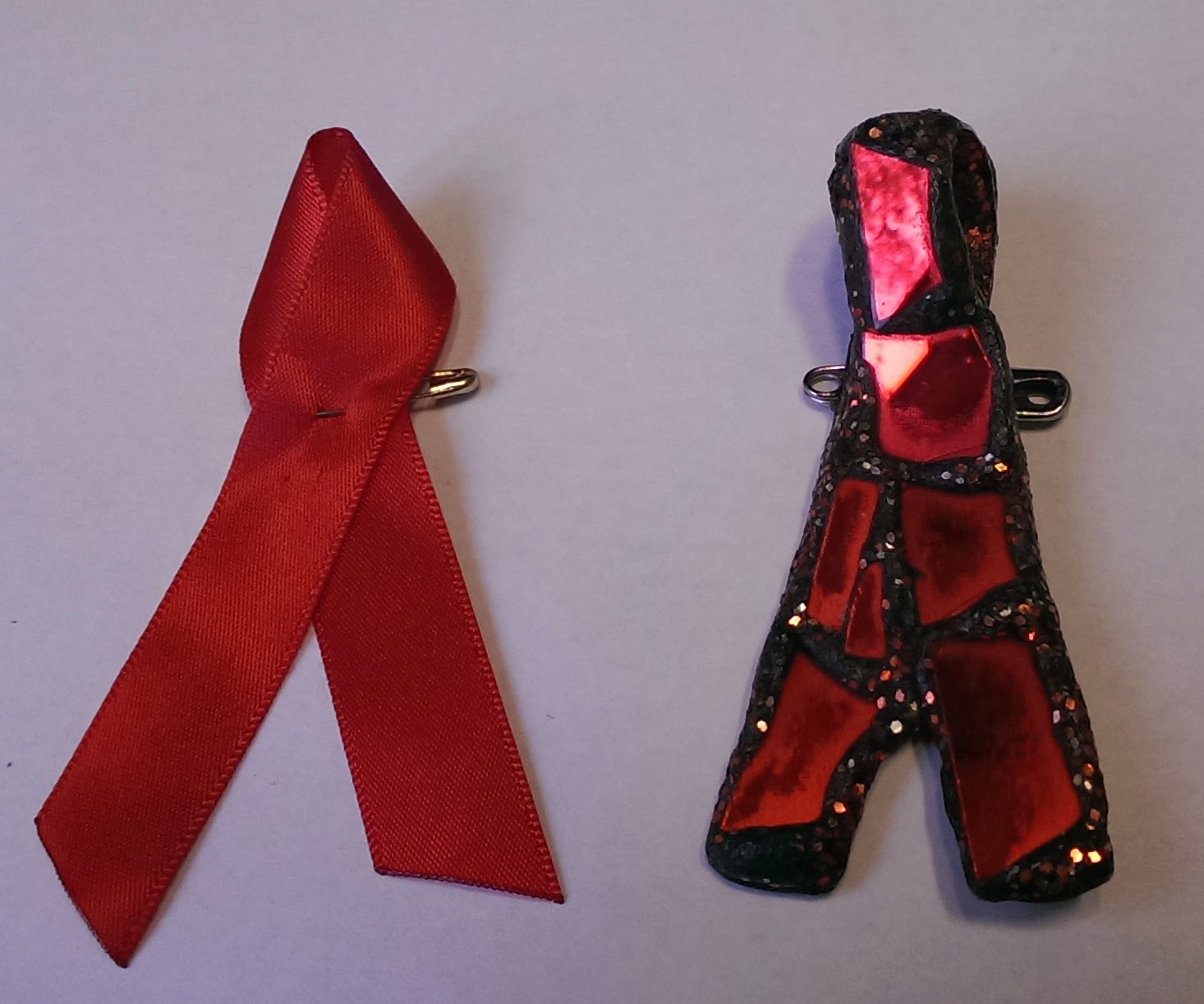
The Red Ribbon: A donation from Lyn Rothman, a friend of the School


With World AIDS Day soon approaching, it seems opportune to mention a special acquisition that the LSHTM Archive received this September. Following a visit to the archives to view the LSHTM HIV/AIDS collection by Lyn Rothman, the founder of AIDS Crisis Trust and current patron and board member of the Elton John AIDS Foundation, she kindly offered to donate a Red Ribbon pendant designed by her friend, Andrew Logan, the English artist and jewellery-maker.

We received, several weeks later, a parcel containing not only the AIDS Red Ribbon pendant designed by the artist but a note on the pendant from Andrew Logan that Lyn had asked him to write about his creation.


The pendant was designed when the first AIDS ribbons appeared and having seen many of his friends die from AIDS, Andrew felt it was a fitting celebration of their lives.

Polish AIDS awareness poster, c.1990s

The original red ribbon designed by New York-based Visual AIDS Artists Caucus in 1991 as a consciousness raising symbol, not as a commercial or trademark tool, and therefore the original creators wished to remain anonymous and the image is free of copyright.

The first red ribbon worn publicly was by Jeremy Irons at the 1991 Tony Awards and soon became renowned as an international symbol of AIDS awareness, becoming adopted as the symbol of World AIDS Day that same year.

To read more about the history of the Red Ribbon please visit: http://www.worldaidsday.org/the-red-ribbon.php


Thursday, 21 November 2013

World AIDS Day Events at LSHTM Archives


For this year's World AIDS Day the London School of Hygiene and Tropical Medicine archives will be hosting two events on the 2nd December 2013.


World AIDS Day: Global Visions


Monday 2rd December, 6pm-7pm, Manson Lecture Theatre, London School of Hygiene and Tropical Medicine, Keppel Street, London, WC1E 7HT


Evening seminar presenting the HIV/AIDS poster collections held by the London School of Hygiene and Tropical Medicine archive and the Wellcome Library.  The Wellcome Library holds one of the world’s largest digitised AIDS poster collections, with over 3000 posters. The LSHTM archives holds sizable collection of its own along with collected campaign ephemera and collected papers. Through the combined archives we shall explore changing attitudes to the disease and the dramatically contrasting cultural attitudes to sex from across the globe.

This joint event organised by the Wellcome Library and the LSHTM Archive will explore the digital and physical poster series of both collections and explore the key themes and contexts of these poster collections through our speakers, Professor Kay Wellings, Professor of Sexual & Reproductive Health Research at LSHTM and donor of the LSHTM poster collection and Julia Nurse, Content Officer at the Wellcome Library and cataloguer of the Wellcome AIDS poster collection.


World AIDS Day: Gems of the HIV/AIDS Collection


Monday 2nd December, 12-2pm, Manson Lecture Foyer, London School of Hygiene and Tropical Medicine, Keppel Street, London, WC1E 7HT


The archives and rare book collections will showcase a display of library and archive material from our extensive HIV/AIDS collections. This includes posters, badges, condoms and other ephemera from the Centre for Sexual and Reproductive Health (CSRH) collection; UK HIV/AIDS campaign material from the AIDS Social History Programme (1988-1994) and the archives of LSHTM Director, Peter Piot, whose archives reflect his the twenty five year experience in combating HIV/AIDS epidemic as both an epidemiologist and then as Executive-Director of UNAIDS, 1996-2008. 

The event is free and open to all. For more information about the World AIDS Day events or the HIV/AIDS archive collection please contact us, archive@lshtm.ac.uk


Selection of ephemera from the Centre for Sexual and Reproductive Health collection